
Do traditional safety cutters still have market value in the AI era?
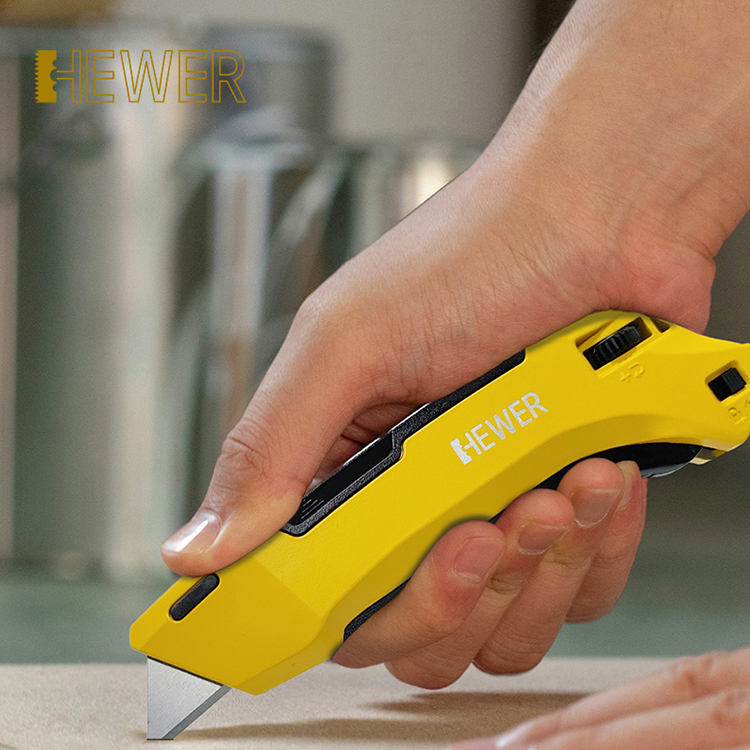
In an era where automation and AI are advancing at breakneck speed, traditional "safety knives" may seem like "low-tech". In fact, their market position in modern industrial systems is even more solid. The following analyzes why these traditional tools remain indispensable from several dimensions:
1. The "Last Mile" Challenge of Automation Technology While AI can drive robotic arms for precise cutting, the real-world logistics and warehousing environment is extremely complex: Non-standardization Challenges: Packages entering and leaving warehouses daily vary in shape, material, and sealing method. Existing automated packing unpackers (ASRs) are expensive and space-consuming. For small and medium-sized enterprises or scenarios requiring frequent changes in work locations, the mobility of handheld safety knives is irreplaceable. Tactile Sensing and Feedback: When using a safety knife, humans can sense whether the blade tip touches the goods inside the box and adjust the force in real time. Current sensing technology needs to achieve this level of precision within milliseconds, which is far more expensive than a few hundred dollars for an industrial safety knife.
2. The stringent requirements of Occupational Safety and Health (HSE): The widespread adoption of AI has reduced manpower, but the remaining positions demand higher standards of "human-machine collaborative safety." Mistake-proof design: Modern safety knives (such as self-rebound blades and concealed blades) minimize human error. Insurance and compliance: Many multinational companies' standard operating procedures (SOPs) mandate the use of safety knives, prohibiting the use of utility knives. This is not a technological issue, but a result of legal and insurance actuarial calculations.
3. The evolution of materials science: Traditional knives do not represent technological stagnation. Modern safety knives are integrating with high technology: Ceramic blades: With wear resistance dozens of times that of steel, they are non-conductive, rust-free, and non-magnetic, making them ideal for use around automated production lines containing sensitive electronic components. Ergonomic optimization: By analyzing human grip posture through data, repetitive strain injury (RSI) is reduced—a product of AI-assisted design.
4. The "Maintenancers" of Automated Equipment: Ironically, the more automated the equipment, the greater the need for safety tools: Troubleshooting: When automated production lines stop due to tangles or jams, maintenance personnel need to carry safety tools for quick clearing. Emergency Response: In the event of automated system failure or accidents, manual tools are the last line of defense.
The Shift in Market Value: The value of traditional safety tools has shifted from a simple "cutting tool" to a "productivity assurance solution."
Dimensions | Traditional utility knife | Modern safety knife | AI/Automation Equipment |
Safety | Extremely low (easy to cut) | Extremely high (automatic blade retraction/concealment) | Depends on sensors and fencing |
Flexibility | High | High | Low (requires fixed deployment) |
Initial Cost | Extremely low | Medium | Extremely high |
Core Values | Sharpness | Zero workplace injuries, protects contents | Scalability, high speed |
Conclusion: AI and automation replace repetitive, monotonous, and large-scale operations, while traditional safety knives hold the line for versatility, emergency response, and precise sensory handling. In the foreseeable future, they will not be competitors, but rather collaborators. As long as the need for "unpacking" and "manual fine-tuning" persists, safety knives will remain the silent yet robust safety liner in modern industry.
Therefore, HEWER adheres to its core philosophy of "making cutting operations more efficient, precise, and safer through creativity and cutting-edge technology," dedicating itself to developing and manufacturing professional safety cutting tools to improve work efficiency, ensure operator safety, and provide professional safety cutting tools and more perfect safety cutting solutions for industries such as packaging, electronics, chemicals, auto parts, food, pharmaceuticals, and medical supplies.